Limescale, Rust, and Legionella: How Anodic Oxidation Restores Heating System Efficiency
The financial viability and energy efficiency of commercial real estate, industrial facilities, and large institutions depend directly on the thermodynamic condition of their HVAC and plumbing systems. Over the years, this infrastructure faces three relentless enemies: mineral scale (calcium carbonate), metal corrosion (rust), and biological fouling (Legionella biofilm).
Traditionally, facility managers combat this problem reactively: using expensive chemicals and regularly performing aggressive acid flushes. However, these methods shorten equipment lifespan and require massive labor expenditures.
Let's look at the problem from an engineering and financial perspective: how much do calcified pipes actually cost you, and how modern anodic oxidation (LegioTerm) achieves a Return on Investment (ROI) in just two years.
1. The Thermodynamics Crisis: How Limescale Steals Your Heat
The purpose of any heat exchanger or boiler is to efficiently transfer thermal energy across a physical barrier. Copper and steel are excellent for this because of their high thermal conductivity (copper is about 400 W/m K, steel is about 50 W/m K).
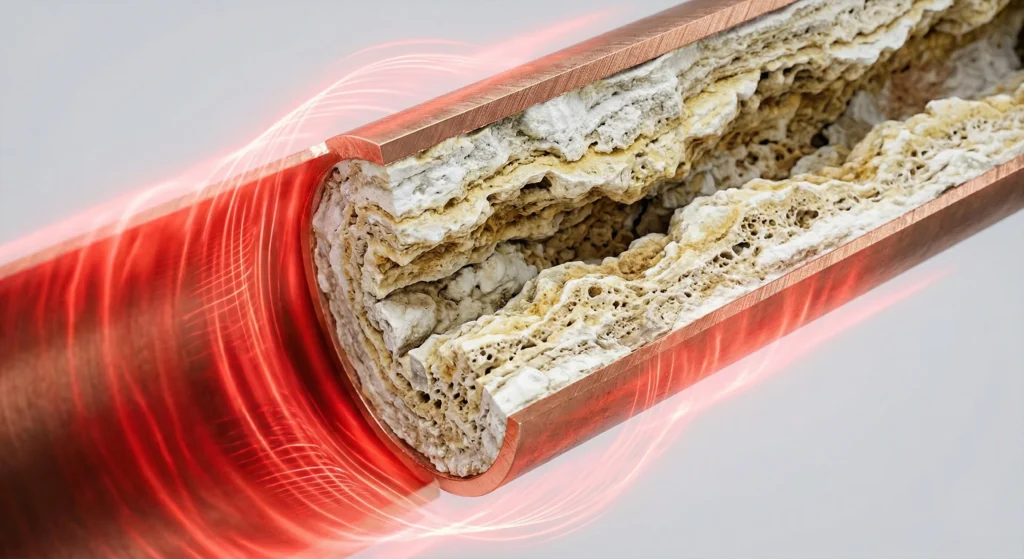
However, as water is heated, dissolved minerals crystallize directly onto the hot walls of the heat exchanger. The thermal conductivity of the resulting limescale (calcium carbonate) is only 1.0 to 2.9 W/m K. Limescale acts as a perfect thermal insulator.
Engineering calculations reveal a harsh reality:
- Just a 0.4 mm layer of scale reduces heat transfer through a metal pipe wall by more than 50%.
- A 0.8 mm layer of scale causes an 8% total heat transfer loss, which inflates fuel consumption by at least 2%.
To compensate for this thermal blockage and reach the required setpoint, the building's automation forces boilers to burn more gas or use more electricity. Proper descaling is a critical step if your goal is reducing heating costs.
2. Hydraulic Resistance and Exponential Electricity Costs (The 1/D^5 Law)
Limescale and rust don't just block heat; they drastically increase the hydraulic resistance in the system. Because scale reduces the internal pipe diameter (D), a ruthless law of fluid dynamics takes over: pressure drop (and pump load) is inversely proportional to the fifth power of the pipe diameter (1/D^5).
What does this mean for a building owner? If scale reduces the internal pipe diameter by just 10%, hydraulic resistance increases by a staggering 69%. To push the same volume of water through a narrowed pipe, your circulation pumps will consume 69% more electricity. Over time, pumps overheat, their lifespan shortens, and building electricity bills spiral out of control.
3. Limescale: The Perfect Incubator for Legionella
Limescale is not smooth like glass. At a microscopic level, it is a highly rough, porous surface with microscopic fissures where water flow slows down. This is the ideal anchor point for bacteria.
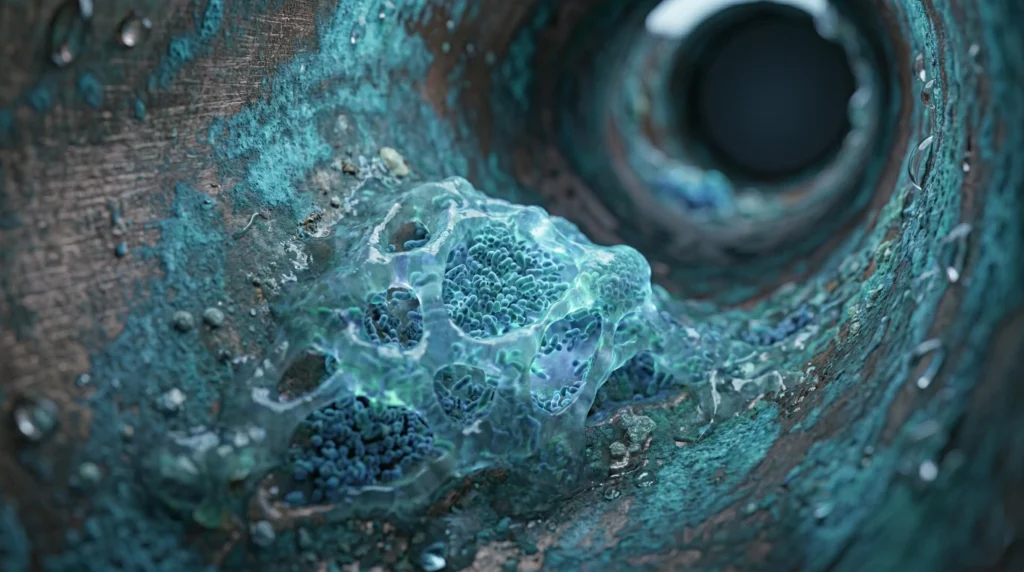
Bacteria create a biofilm here—a slimy matrix (EPS) that protects Legionella from outside threats. Biofilm is another excellent thermal insulator. This is exactly why traditional "thermal shocks" (heating the system to 70C) fail. The heat simply cannot penetrate through the layers of scale and biofilm, allowing the bacteria to survive, multiply, and put the building at risk of severe public health fines.
4. The "Descaling" Effect: How Anodic Oxidation Solves Both Problems
The innovative solution that allows you to abandon chemical flushing is electrochemical anodic oxidation (e.g., LegioTerm). This technology doesn't just kill bacteria; it actively descales the piping network.
How does it work at a physical and chemical level?
- Altering Scale Structure (Polymorphism): The electromagnetic field alters the crystallization process of calcium carbonate. Instead of forming hard, sticky calcite, the water forms aragonite—soft, microscopic crystals that do not stick to heat exchangers and are easily flushed out with the flow.
- Dissolving Existing Scale: By altering the water's "Zeta potential," old scale loses its adhesion to the metal and slowly flakes off, restoring the factory pipe diameter.
- Destroying Biofilm: The incredibly strong hydroxyl radicals generated at the anode destroy the sticky biofilm matrix. Stripped of its protection and its limescale "incubator," biological contamination (including Legionella) is completely eradicated.
5. Financial Return (ROI): Payback in 2 to 5 Years
Traditional chemical acid washing of boilers and heat exchangers requires specialized personnel and costs thousands of euros each time. Furthermore, the acid slowly eats away at the metal itself, accelerating the day you have to replace expensive equipment.
By installing an anodic oxidation system, a commercial building experiences immediate financial benefits:
- Eliminating Chemicals: 100% elimination of costs for expensive biocides, antiscalants, and acid flushes.
- Energy Recovery: Restored heat exchanger conductivity recovers the 2% to 10% thermal efficiency lost to scale, while clean pipes drastically reduce pump electricity consumption.
- Long-Term Protection: The equipment operates automatically with very low operational costs (the reactor requires minimal electricity).
According to rigorous studies conducted by the US General Services Administration (GSA) and the National Renewable Energy Laboratory (NREL), electrochemical water treatment systems yield a Savings-to-Investment Ratio (SIR) of 5.0. When combining saved energy, water, and maintenance costs, such a system in a commercial building fully pays for itself in just 2.2 to 5 years.
This is not just Legionella prevention. It is a smart engineering investment that increases building value, ensures sustainable operation, and directly reduces your operating expenses.
Modern Building Engineering: Highest Standards of Air and Water Hygiene from a Single Source
Thermal Shock and Chlorination: Why Old Legionella Eradication Methods Destroy Your Pipes